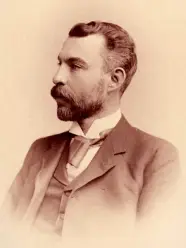
Bishop Anderson had many positions in the Church in Canada. He was the Dean of Rupert’s Land, the Dean of Ottawa, Co-Adjutor of Rupert’s Land, Bishop of British Columbia, the Dominion President of the Canadian Legion, and the Bishop of Red River.
About Us
A History in Stone
A guide to the historic graveyard
of St. John’s Cathedral
St. John's Anglican Cemetery
St. John’s is the oldest Anglican parish west of the Great Lakes. It was founded in 1820, when the Rev. John West arrived from England to serve as chaplain to the Hudson’s Bay Company, and as missionary to this part of the world.The graveyard surrounding the Cathedral predates the parish. It was established by the first group of Selkirk settlers in 1812.
The site for the church was chosen by Lord Selkirk in 1817, prompted no doubt by the fact that the graveyard was already there. Unfortunately, there are no records of the earliest burials. The diary of John West records that he presided at the first burial conducted by a cleric, that of John Bruce, who died at age 84 and was buried on June 4, 1821.
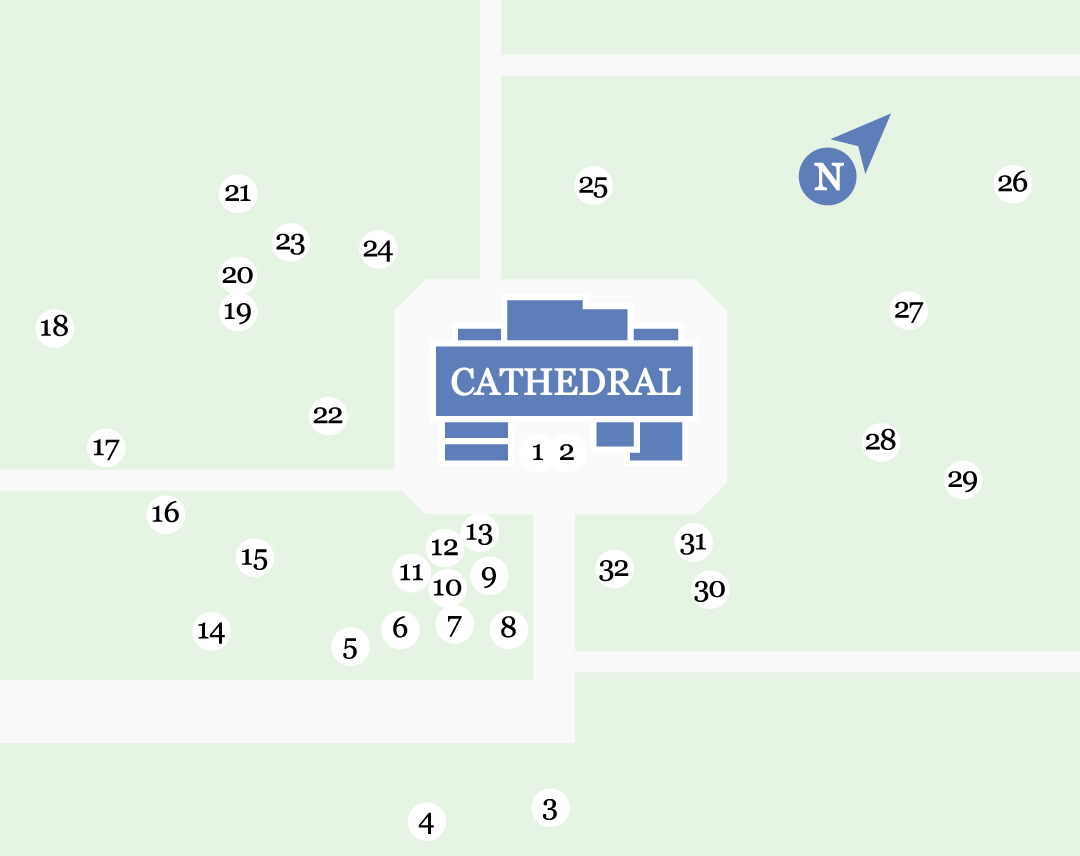
Many of the founding families of Winnipeg are buried in our cemetery and is the final resting place of many of Manitoba’s prominent historical figures; some which are listed below. For a more complete map of our cemetery, please see our office.
We hope this guide makes your walk through Winnipeg’s history both informative and enjoyable. Please click below on a name for more information below. They are listed lphabetically by last name.
If you’d like a complete search of all the memorials, please go to the Find a Grave website.
- Sir Hugh John McDonald
- Archdeacon Robert McDonald
- Sir Augustus Nanton
- Premier John Norquay
- John Pritchard
- John Peter Pruden
- James Richardson Sr.
- Donald Ross
- Margaret Scott
- Louis Ralph Sherman
- Lt. Gov. John C. Shultz
- Simpson Baby, George
- Sinclair Monument, Colin Sinclair
- Sir Sam Steel
- Isaac O. Stringer
- John Sutherland
- James Thomson
- Lt. Gov. William Tupper
- Lt. Gov. Errick Willis
Spring Flowers
Every spring, a group of enthusiastic gardeners drawn from the Cathedral congregation gathers to plant flowers on selected graves. For an annual fee, families can arrange to have flowers planted on graves of their loved ones. The fee not only buys the flowers but also augments the fund that supports and maintains the care and upkeep of the graveyard.
Historic Marker
This marker was erected by the Cathedral Vestry and Cemetery Committee in 1954 to indicate the important dates in the history of the Parish and Churchyard. The map at the bottom of the marker shows the relative positions of the four churches that have stood on this site and the dates they were erected.
The Sun Dial
This bronze and copper Sun Dial was brought from England by Sir Augustus Nanton and stood in the grounds of his home off Roslyn Road. This piece of art was crafted by John Bell in 1659 at London. Its epitaph reads “As tyme and houres passeth awaye So doethye life of Man decaye.”
Sir Augustus Nanton
A young stockbroker from Eastern Canada, Nanton was sent to Winnipeg in 1883 by his firm, Osler and Hammond, to open a branch office. He very soon became one of Winnipeg’s 19 millionaires, and the firm became Osler, Hammond and Nanton. Nanton served his adopted city well, and was involved in various community projects.
He was also one of three members of the Canadian Committee of the Hudson’s Bay Company in 1913.
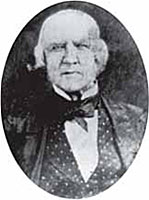
John Peter Pruden (d. 1868, aged 80).
Pruden was a native of Edmonton, near London, England, and served the Hudson’s Bay Company from 1791 to 1837, working his way up from apprentice trader to the position of Chief Factor. Much of his service was in what is now central Alberta, and it is more than likely that the city of Edmonton owes its name to Pruden, who was Chief Factor of the HBC trading post there. On retirement, Pruden made his home in the Red River Settlement, where he was appointed a Councilor of Assiniboia. His gravestone is interesting in that it records the name of his first wife, Nancy, a Cree woman who died in 1838, but it makes no mention of his second wife, Anne Armstrong. Judging from letters and journals of the day, Pruden’s second foray into marriage was a lot less successful than his first.
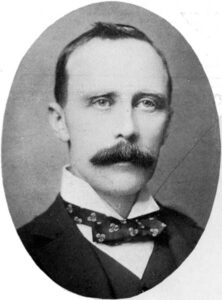
James Thomson (d. 1933, aged 73).
Chief Factor/Land and Fur Trade Commissioner for the Hudson’s Bay Co. Thomson was a native of the Ørkneys, like many of the Hudson’s Bay Company employees.
Lt. Gov. William Tupper (d. 1947, aged 85)
William was the second son of Sir Charles Tupper, one of the Fathers of Confederation. He lived most of his life in Manitoba, coming west in 1885 to fight in the Northwest Rebellion. He served as Lieutenant Governor from 1934 to 1940. He and Mrs. Tupper entertained King George VI and Queen Elizabeth in May, 1939, at Government House, Winnipeg.
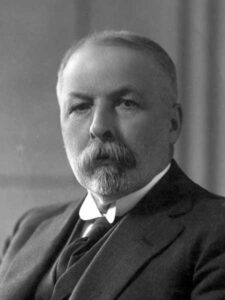
Sir Hugh John Macdonald (d. 1929, aged 79)
Sir Hugh John Macdonald was the son of Sir John A Macdonald, the first Prime Minister of Canada and the Father of Confederation. Hugh John did much for the growth of Manitoba as a Province and did much for the growth of the Church in Manitoba.
He first came west as a young ensign in the Wolseley Expedition which was sent to repress the Riel rebellion in 1870. He returned to Winnipeg in 1881, after the death of his first wife. He served with the Winnipeg Rifles in the 1885 Northwest rebellion, was an MP for Winnipeg, Premier of Manitoba, and was Chief Magistrate of Winnipeg from 1911 until his death. He was known to Winnipeggers as “Our Hugh John”.
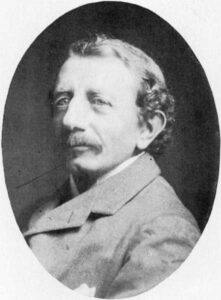
John Ogle Anderson (d. 1969, aged 57)
Robert Machray (d. 1904. aged 72)
A force to be reckoned with in the history of western Canada, Machray was born in Aberdeen, Scotland in 1841. An Anglican by choice, he succeeded David Anderson as Bishop of Rupert’s Land in 1865. His term of office lasted for more than 35 years. Machray’s bishopric in Red River was served during tumultuous times – the Riel Rebellion of 1869, the creation of the Province of Manitoba in 1870, the incorporation of the City of Winnipeg in 1873, and the coming of the railroad in 1885.
While he was bishop he also served as Headmaster of St. John’s College School, and Warden of St. John’s College (now part of the University of Manitoba), which he also founded. He was Chancellor of the University of Manitoba during his tenure as Bishop. His interest in the welfare of the community in which he lived also led to his founding of community schools, one of which is Machray School on Mountain Avenue. In 1890, Machray became the first Primate of All Canada when the Church of England in Canada was established as a separate Communion, no longer under the direct governance of the Church of England.
The Cathedral has many memorials in his memory.
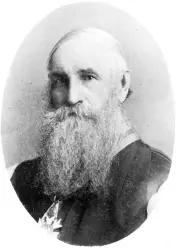
Isaac Stringer (d. 1934, aged 68)
Archbishop Stringer’s story is an epic of the Canadian Church. The early years of his ministry were spent in the Diocese of McKenzie River as a missionary to the Inuit people of Herschel Island, where he translated the gospels into the indigenous language. In 1902, warned of eye trouble, he accepted an invitation to be Bishop of Whitehorse and was consecrated in St. John’s Cathedral by Archbishop Matheson. In 1905 he was elected Bishop of Rupert’s Land , and became Metropolitan in 1931.
Stringer is known as “the Bishop who ate his boots.” In 1909, on a visit to the Arctic, he attempted to return to Dawson City by a shortcut over the Rockies. Unfortunately, the weather turned foul, and the small party quickly ran out of food. Because the game animals had already migrated, they weren’t able to trap or hunt anything. The bishop’s diary records: “Thursday, October 21 – Breakfast of sealskin boots, soles and tops boiled and toasted. Soles better than tops.”
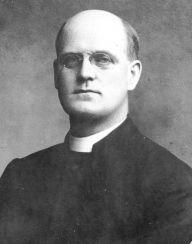
Samuel Pritchard Matheson (d. 1942, aged 90)
Bishop Matheson was the first native-born Bishop of the Diocese, having been born in the Red River Settlement in 1852. His maternal grandfather was John Pritchard, one of the settlement’s leading citizens and his father’s family were of Selkirk settler stock. Matheson was educated at St. John’s College. He taught at St. John’s College School and was also the Chancellor.
In 1875 he was ordered to the diaconate by Archbishop Machray. In 1902 he became Dean of the Cathedral, then Bishop of Rupert’s Land in 1905, and Primate of All Canada in 1909. Among Archbishop Matheson’s many accomplishments was the building of the fourth church on this site, the present Cathedral, in 1926. He did much to build the present Cathedral and with his wife, Mrs. S.P. Matheson, spent many long hours making the altar hangings and linens which beautify this Cathedral. Matheson was greatly loved by all who knew and worked with him.
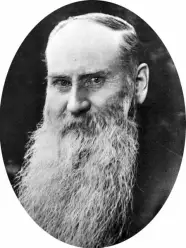
Louis Ralph Sherman (d. 1953, aged 63)
Louis Ralph Sherman was very important in the growth and learning of the Church. He was Archbishop of Rupert’s Land and Metropolitan of the Province of Rupert’s Land. He was the Chancellor of St. John’s College and the Dean of Quebec. He died on July 31, 1953 at the age of 63 years of age.
The Sinclair Monument
Chief Factor Sinclair had two sons by aboriginal woman. The boys were sent to England for schooling. One became a Captain in the Royal Navy. Years later this young man returned to Red River to find his mother’s grave. The remains were removed and interred in the Cathedral Cemetery and this Monument was erected. This son is buried here with his mother.
Captain Colin Sinclair (d. 1901, aged 84)
Colin Sinclair was the youngest son of Chief Factor William Sinclair and his country wife Nahoway of York Factory. It was the tradition to send sons to England to be educated, a tradition which grieved the native mothers who hated to be separated from their children. Colin was spirited away and sent to England, which broke his mother’s heart. She never saw her son again. Years later, after a successful career as a seaman and explorer, now-Captain Colin Sinclair returned to the land of his birth and lived with his cousins, the Inksters, until his death in 1901. His tomb bears an inscription honouring his mother, Margaret Nahoway Sinclair, who is buried in the plot beside him.
Margaret Scott (d. 1931, aged 76)
Margaret Scott was one of the pioneers of social work in Winnipeg in the early years of the twentieth century. She founded the All People’s Mission which later became known as Margaret Scott Nursing Mission.
Mrs. Scott has been called “The Angel of Poverty Row” and “St. Margaret of Winnipeg”, for her work among the poorest of the poor in Winnipeg. She arrived in Winnipeg in 1886 from Colborne, Ontario. She had been recently widowed and wanted to start a new life. She worked in the Dominion Land Office, but gave up paid employment to work among the sick.
She devoted her whole life to caring for the needy. Her work was supported by private donations, and the parishioners of St. John’s presented her with a pony and trap so that she could make her rounds. In 1904, she established the Margaret Scott Nursing Mission, which, in addition to caring for the sick, became a centre for training and support of district nurses, and by 1906, it was necessary to increase the staff. Funding was provided by the City of Winnipeg, and the Mission gained a national reputation. Margaret Scott was wont to say: “If in trying to serve God I have been privileged to cheer and comfort others, my highest aim has been obtained.”
Her gravestone records the esteem in which she was held in her adopted city.
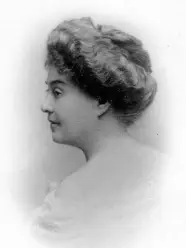
George Frederick Coombes (d. 1922, aged 66)
From 1880 to 1890, Dean Coombes was Professor of Music, Precenter of the Cathedral, and lecturer in the Classics at St. John’s College. When Archbishop Matheson was elected Metropolitan, Dean Coombes became Dean of Rupert’s Land. He was Prolocuture of the Provincial Synod of Rupert’s Land from 1909 to 1920.
John Sutherland (d. 1863, aged 102)
A native of Sutherlandshire, Scotland, John Sutherland came to the Red River Settlement with one of the groups of Lord Selkirk Settlers nearly 160 years ago.
Like many of the Selkirk Settlers, Sutherland was a Presbyterian. He attended St. John’s along with many of his co-religionists for over thirty years, until the arrival of the Rev. John Black in 1852 and the building of Kildonan Presbyterian Church. Sutherland was one of the first elders of Kildonan Church. Even after Black’s arrival, the Presbyterian settlers continued their practice of interment in the St. John’s Cemetery.
John Pritchard (d. 1855, aged 79)
John Pritchard was one of the real pioneers of the West. He came out from England as a young boy and later worked in the fur trade for the X.Y. Company and later for the Hudson’s Bay Company.
He was present at the Seven Oaks Massacre in June 1816 when Governor Robert Semple and 20 of his men were killed in a battle with men of the Nor’West Company who sought to annihilate the Selkirk Settlers. Pritchard was one of the three or four whose life was spared in that massacre and he went on to become a leading citizen in the Settlement.
The late Archbishop Matheson was his grandson.
The Ven. Robert McDonald (d. 1913, aged 84)
McDonald was born in Point Douglas and was educated at the Red River Academy (St. John’s School). He was ordained in 1852 by Bishop Anderson and spent ten years serving the Ojibway people from the mission at White Dog before moving to the Mackenzie River district as a missionary to the Loucheux people. At the end of two years he was able to baptize the first converts to Christianity. On retirement he returned to Point Douglas and devoted the later years of his life to compiling a Tudukh language dictionary which was published in 1911. He is pictured in the Great West Window in the Cathedral.
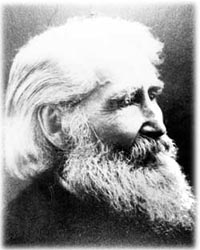
John Norquay (d. 1889, aged 48)
John Norquay became the Premier of Manitoba in1878, following Premier Davis. The sixth premier of Manitoba, John Norquay was the first (and last, to date) premier of Manitoba of native heritage. Norquay was born in the Red River settlement in 1841, of Scottish/native descent. Orphaned at an early age, he was raised by family members and educated at the Red River Academy. He became a teacher and a farmer. His mastery of six languages was an asset in the multilingual Red River Settlement, and in 1871 he was elected MLA for the constituency of High Bluff in the first parliament of Manitoba. The better-known Louis Riel was the spokesperson for the French Metis, and Norquay was the leader of the English-speaking people of mixed blood. Norquay supported Riel’s aims for the people of Red River, but disapproved of his tactics, and was instrumental, along with Riel, in attaining provincial status for Manitoba in 1870. He served as premier of the new province from 1878 to 1887. His Government fell in 1887 as a result of questionnable financial transactions between the Government and the Hudson’s Bay Railway.
A member of St. John’s, Norquay was a delegate to the first Synod of the Ecclesiastical Province of Rupert’s Land in 1875.
He was buried at St. John’s Cemetery where a monument bears this message:
“To the Memory of The Hon. John Norquay
Who was for many years Premier of Manitoba.
By his sudden and all too early death
His native land lost an eloquent speaker
An honest Statesman and a true friend.
Born May 8, 1841, Died July 5, 1889
This monument is a Public expression of his sterling worth.”
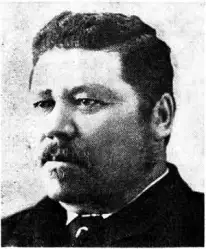
Simpson Baby, George (d. 1832)
This tiny grave is that of the eight-month-old son of Sir George Simpson, Governor of the Hudson’s Bay Co., who died in 1860 in Upper Canada. The child is not named on the stone, but in Cathedral records he is listed as George.
Mary Jones (d. 1836, aged 31) and her son David Lloyd (d. 1830, in infancy)
Mrs. Jones was the wife of Rev. David Jones, the second Anglican priest to come to the Red River Settlement. Mary worked with him to provide education for the children of the Settlers, the Hudson’s Bay Co. officers and native children. She devoted much of her time to the Red River Academy.
The monument was erected by the girls of the Red River Academy.
Dean J. W. Matheson (d. 1939)
Dean Matheson joined the staff of St. John’s Cathedral in 1905. He succeeded Dean Coombes as Dean of Divinity in 1912. Dean Matheson was regarded as one of the best scholars in the Church in Western Canada. A man of forceful personality, he left an impression on students and associates not easily forgotten !
Margaret McTavish Konantz M.P., née Rogers (d. 1967, aged 68)
Margart Kohantz was related to the old Rogers family of Winnipeg. She was elected to Parliament in 1960, and represented the riding of Winnipeg South.
James Richardson Sr. (d. 1939, aged 54)
The founder of James Richardson and Sons and The Pioneer Grain Company, Richardson was also a pioneer in Canadian aviation.
James Richardson supported the daring experiments of the first bush pilots of the Canadian North. He formed Western Canada Airways which was incorporated in 1926.
Richardson was also a prominent grain merchant. He formed the company James A. Richardson, now a diverse Canada wide enterprise. The Company’s Head Office is the Richardson Building at the corner of Portage and Main, in Winnipeg.
The Richardson family has been a strong presence on both the political and cultural scene in Winnipeg.
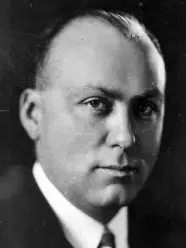
Lucy Franks (d. 1847, aged 11), daughter of James Franks.
This is the oldest grave in this cemetery on which the epitaph is still legible. Lucy died in 1817 at the age of 14 years, three years before the arrival of John West, the first Protestant minister in Western Canada.
Despite the fact that her gravestone indicates that she died in 1817, historians maintain the style of the headstone is of a period much later than 1817. One theory has it that an enthusiastic member of the Cathedral, while cleaning and refurbishing stones, mistook the 4 in 1847 for a 1 and incised the date incorrectly. According to Cathedral records, Lucy Franks died in 1847, and may well have been a victim of one of the cholera outbreaks that assailed the colony in the late 1840s.
Colin Inkster (d. 1934, aged 91)
Colin Inkster had a lifelong connection with St. John’s Cathedral. He was the son of Orkney John Inkster, who was a leading merchant in the Red River Settlement. Colin grew up at Seven Oaks House, and was educated at St. John’s College School. He was a member of the Legislative Council of Manitoba and served as Speaker of the Assembly. In 1878 he resigned his seat to become High Sheriff of Manitoba, an office he held until his retirement. Inkster’s personal history closely parallels that of the City of Winnipeg and the Province of Manitoba.
Like his father before him, Colin Inkster served both his community and his church. John Inkster served as a Warden of St. John’s and Colin followed in his father’s footsteps, and served as Warden for over 60 years! He knew Archbishop Cockran well. He greeted Archbishop Machray when the Archbishop arrived at St. Paul, Mn., and travelled with him to Winnipeg, arriving on Oct. 13, 1865. He was a member of the first Provincial Synod of Rupert’s Land in 1875.
When the ‘new’ Cathedral was built in 1926, Colin, along with Archbishop Matheson, was a major force in fund-raising and planning. His contributions to life in the Red River Settlement, the City of Winnipeg, the Province of Manitoba, and the Anglican Church in Rupert’s Land are recognized by his inclusion among the leading figures in the development of the church, depicted in the Great West Window, which was installed in 1970 to mark the 150 anniversary of the Parish. There is, in the Cathedral a plaque in memory of this man along with the stained glass portrait.
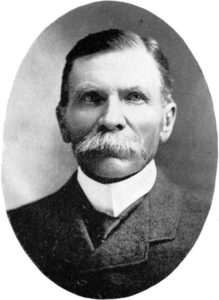
The Soldiers Monument
The Batoche/Fish Creek Memorial
This tomb was erected in 1886 by the Winnipeg Rifles (now the Royal Winnipeg Rifles) to honour comrades who were killed at or died from wounds received at the battles of Fish Creek (April 24) and Batoche (May 12) in the Northwest Rebellion, 1885. The bodies of Privates James Frazier, Richard Hardisty, A.M. Fergusson, George Wheeles and W. Ennis, Corporal John Code, and Lieutenant Charles Swineford are interred here. The memorial also commemorates Privates Alex Watson and J. Hutchinson, who are buried in St. Catherine’s, Ontario and St. Thomas, Ontario respectively.
The Cathedral has a long-standing relationship with the Royal Winnipeg Rifles. The regiment’s drum, bugle and colours are housed in the Cathedral, and the North Transept Window depicts the regiment’s involvement in Canadian military engagements from the Northwest Rebellion to Korea. This grave is decorated each year on Remembrance Day by the veterans of the Royal Winnipeg Rifles. An annual service is conducted by one of the Cathedral Clerg
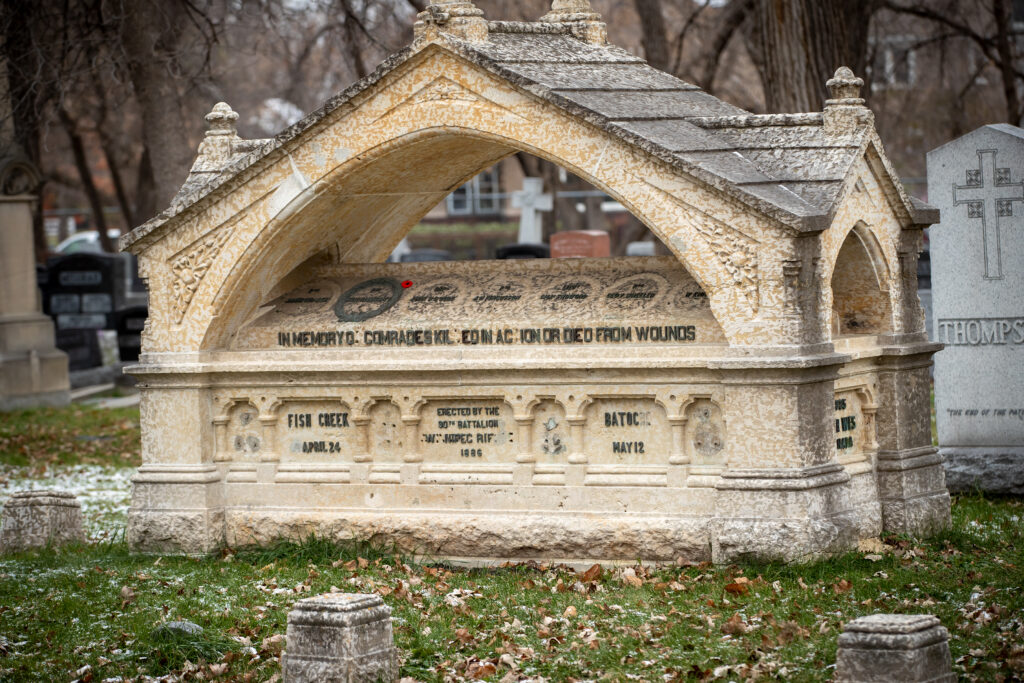
Lt. Gov. John Christian Schultz
Sir John Christian Schultz (d. 1896, aged 56)
Schultz was the fifth Lieutenant-Governor of Manitoba. He arrived in Winnipeg in 1860, and established himself as an independent fur trader, in opposition to the Hudson’s Bay Company. He and his brother also owned the Royal Hotel, at the corner of Portage and Main, and he later opened a drug store and practiced medicine, although there is no record of his ever having earned an MD! He also co-owned the Nor’Wester, a newspaper which was noted for its anti-HBC editorial policy. Schultz was a key figure in the Riel Rebellion, and was incarcerated at Upper Fort Garry by Riel. He escaped and made his way to Ottawa where he rallied opposition to Riel. As leader of the Canada First party, Schultz was pro-Confederation, but he was opposed to Riel’s vision. He served as MP for Lisgar from 1871 to 1882 and was later appointed to the Senate. He was appointed Lieutenant Governor of Manitoba in 1889.
While Schultz accomplished much, he was not a popular member of the community. The story goes that, on viewing the fulsome inscription on Schultz’s gravestone, Sheriff Colin Inkster was moved to remark, “What a pity we knew him.
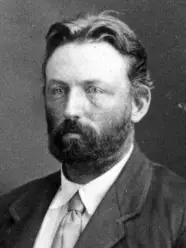
W. F. Luxton
William Fisher Luxton (d. 1907, aged 63)
A native of England, Luxton was the first public school teacher in Winnipeg. In 1872 he and James Kenny co-founded the Manitoba Free Press (later the Winnipeg Free Press). He made it “the sharp tongued organ of the Liberal Party”. It was often called the most representative voice of the North-West. He was the elected Liberal Member, representing the riding of Rockwood.
Luxton played a prominent part in having Winnipeg incorporated as a city in 1873. A street, five blocks north of the Cathedral, retains his name.
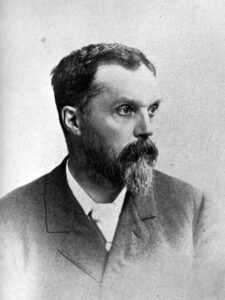
Sir Samuel Steele (d. 1919, aged 70)
Sir Sam’s story is the stuff of legends. Sir Sam Steele was a soldier and a police officer. He was born near Orillia, Upper Canada. In 1866 he joined the Canadian Militia and served during the Fenian Raids and as part of the Red River Expedition of 1870. He was one of the first to enlist in “A” Battery, RCA, on its formation in 1871. In 1873, he joined the newly organized Northwest Mounted Police (later the RCMP), and rose rapidly through the ranks. He served with the force for 30 years and became one of its legendary heroes. He was a member of the team that negotiated with the U.S. the terms of Sitting Bull’s exile in Canada. He took part in a 1000 mile march to the Rockies in 1874. In the 1880s, Steele was responsible for maintaining law and order as the CPR was being built across Western Canada. He served in the Northwest rebellion in 1885. During the Klondike Gold Rush he was in charge of the Detachments in the Yukon and in British Columbia.
In 1899, Steele took leave of absence from the NWMP to serve with the Lord Strathcona Horse Regiment in the Boer War. He commanded the LSH during World War I. On returning to Canada he commanded the Military District in Calgary and then Winnipeg.
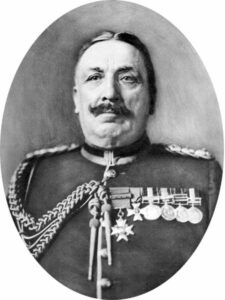
Lt. Gov. Errick F. Willis (d. 1967, aged 70)
Errick Willis was the first born-in-Manitoba Lieutenant Governor of the Province. A lawyer by training and a farmer by inclination, Willis served as a Member of the Legislative Assembly and was Minister of Agriculture (1958-1960).
Willis became leader of the Conservative Party of Manitoba in 1936. In 1940 he led the Conservatives in the Coalition Government under Premier Bracken. He was appointed Lieutenant Governor of Manitoba in 1960. His term of office extended until 1966.
An ardent curler, he was a member of the Canadian Olympic Curling team which brought home the gold medal from Lake Placid in 1932.
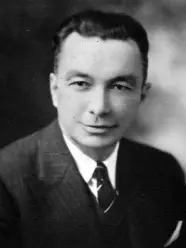
John Inkster (d. 1874, aged 74).
Orkney John, as he was know in the Red River Settlement, was a stonemason who arrived in the settlement in 1821. Within a few years, Inkster had become a prosperous farmer and trader, and built Seven Oaks House (north of the Cathedral on Main Street and Rupertsland Avenue). The house is now a museum, maintained in the style of the Red River Settlement days. At Seven Oaks, Inkster and his wife Mary (nee Sinclair) raised their nine children, among them a son Colin, who was eventually to follow in his father’s footsteps as a Warden of St. John’s Cathedral.
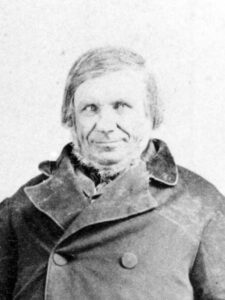
Other prominent historical figures in our cemetery:
Donald Ross (d. 1852, aged 54)
Donald Ross came from Scotland towork for the Hudson’s Bay Company as a clerk. By the early 1830s he had been promoted to Chief Factor and served at Norway House. In 1820 he married Mary, the daughter of Selkirk Settler Alexander McBeath.
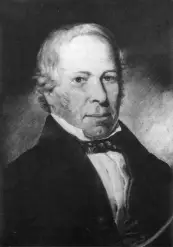
Thomas & Phoebe Bunn
Thomas (d. 1853, aged 88) and Phoebe (nee Sinclair, d. 1848, but her age is unrecorded)
The Bunns were the first couple married by an Anglican priest in western Canada. They were married at Rock Point in 1820 by the Rev. John West as he made his way south to the Red River Settlement. Until the arrival of clergy, common law marriage was the norm (it was called mariage au facon du pays, and the women, who were often native or the daughters of fur traders and native women, were referred to as country wives).
“The first records in Rev. John West’s church registers are the marriage at the Rock Depot, which was about fifty miles south of York Factory, of Thomas Bunn and Phoebe Sinclair, on September 9, 1820, and on the same date the baptism of their four children. This was a rather unusual occurrence according to present day customs; but it must be remembered that prior to West’s arrival there were no ministers anywhere in the northern wastes of Rupert’s Land.”
source: Manitoba Historical Society
James Ashdown (d. 1924, aged 80) and seven other members of the Ashdown family.
James Ashdown was one of the founding fathers of the City of Winnipeg. He arrived in the Red River Settlement in 1868, on foot from St. Cloud. He started a tinsmithing business, which grew into a hardware store, and eventually became one of the largest hardware enterprises in Canada. The Ashdown home at the corner of Wellington Crescent and Academy Road, now a restaurant, was one of the showplaces of Winnipeg.
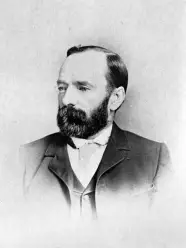
Alexander Logan (d. 1894, aged 52)
Three-time mayor of Winnipeg, Logan was a land speculator in the City’s early days. He is credited with persuading the Federal Government of the day to build the CPR linethrough Winnipeg, rather than Selkirk or Brandon. He also introduced the vote-by-ballot in municipal elections. Logan served on the Vestry of St. John’s from 1880 to 1884.
Robert Logan (d.1866, aged 91).
As a Chief Factor of the Hudson’s Bay Company, Logan traded all over Rupert’s Land, the vast territory that stretched from the eastern shore of the Hudson’s Bay to the Rockies. On his retirement, Logan took up residence in the Red River Settlement, and was one of the community’s most prominent members. Hudson’s Bay Governor George Simpson appointed Logan, Dr. John Bunn and Alexander Ross as the first Wardens of St. John’s.
William Alloway (d. 1930, aged 78)
Alloway came to Winnipeg in 1870 with the Wolseley Expedition. After leaving the army, he settled here and began a successful business career. In 1921, Alloway and his wife established Canada’s first community foundation, the Winnipeg Foundation, with a $100,000 gift. The Foundation continues to support local charities.